
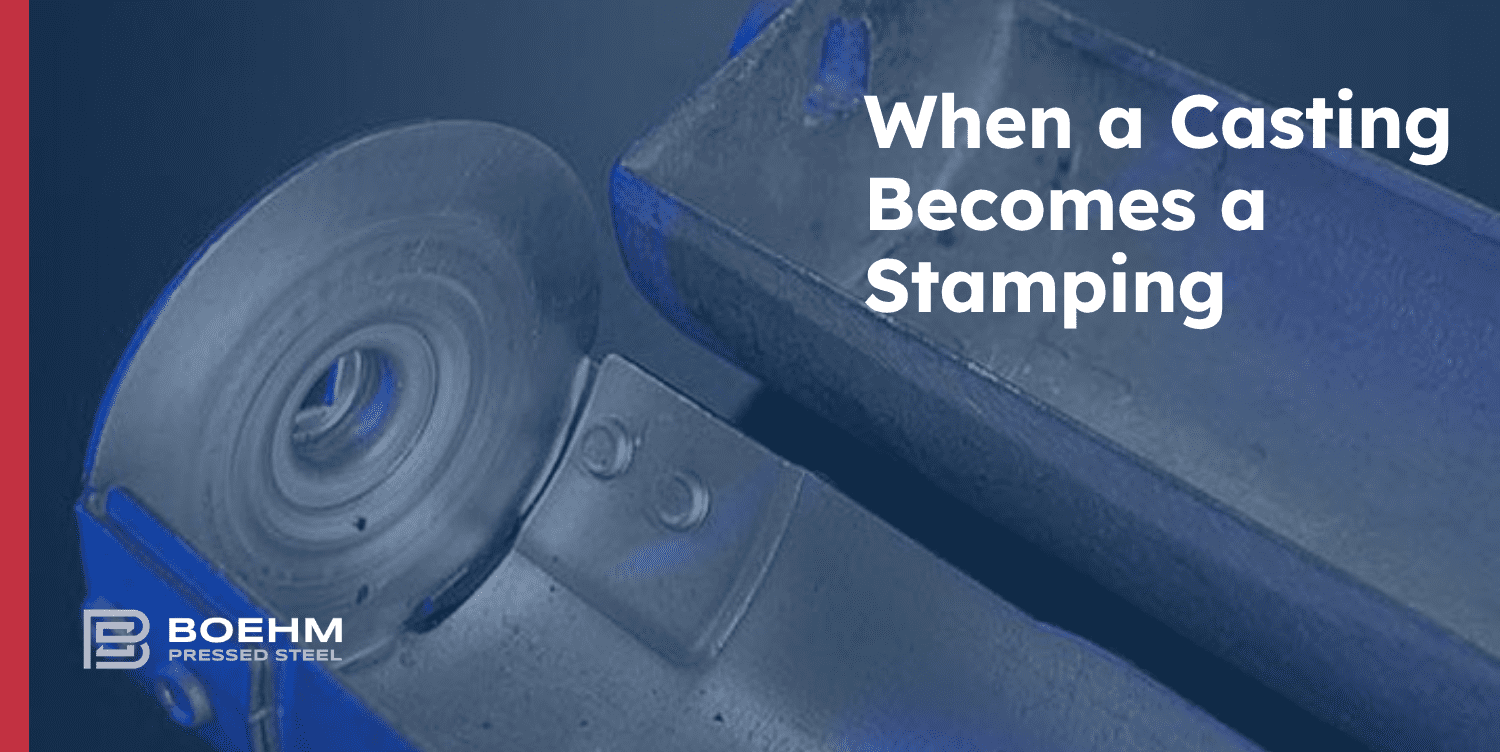
When a Casting Becomes a Stamping: How Re-Engineering Parts Can Cut Costs and Lead Times
There’s a question worth asking about almost every cast metal part in your product line: does this have to be a casting?
For many manufacturers, the answer is no. And the decision to re-engineer a casting into a stamping, when done right, can deliver meaningful reductions in cost, lead time, and material waste without sacrificing the tolerances or performance your application demands.
At Boehm Pressed Steel, re-engineering castings to stampings is one of our most impactful capabilities. It’s also one of the most underutilized conversations we have with new customers.
Why Castings Get Specified in the First Place
Castings are the right choice for many applications. Complex three-dimensional geometries, thick cross-sections, and parts that require material properties difficult to achieve in sheet metal are all legitimate reasons to cast.
But castings also come with tradeoffs that are easy to overlook when a part is first designed. Tooling costs are high. Lead times are long. Per-part costs scale poorly at low-to-mid volumes. Secondary machining operations are often required to achieve finished tolerances. And when something needs to change – a design revision, a material upgrade, a tolerance update – the casting process doesn’t make that easy or cheap.
A lot of parts that are being cast today were specified as castings early in the design process, before someone asked whether a stamped alternative could do the same job better.
What Makes a Good Candidate for Conversion
Not every casting can or should become a stamping. But many can, and the candidates tend to share a few characteristics.
Parts with relatively uniform wall thicknesses, features that can be formed from sheet stock, and applications where weight savings are a bonus rather than a liability often convert cleanly. Brackets, structural members, clamps, covers, housings, and mounting components are frequent candidates across industries from agriculture to energy to mining.
The conversion process typically involves a Boehm engineer reviewing the existing casting geometry alongside the functional requirements of the part, not just what it looks like, but what it actually needs to do. From there, we identify what can be formed, what tolerances are genuinely required versus over-specified, and how to incorporate features that might currently require separate machining operations into the stamping process itself.
The goal is a stamped part that performs identically, or better, at a lower cost and on a faster timeline.
What the Conversion Can Deliver
The advantages vary by application, but across the conversions we’ve done, several benefits appear consistently.
Lower per-part cost. Stamping uses sheet metal efficiently, with far less material waste than casting. Combined with faster cycle times and automated production, the per-part economics are typically more favorable – especially at the volumes where many manufacturers operate.
Faster lead times. Once tooling is established, stamped parts move through production quickly. There’s no waiting for poured metal to cure, no extensive secondary machining queue, no long casting lead times standing between your design and your production line.
Tighter tolerances. Boehm can reverse engineer castings, molded and machined parts into stampings that maintain close tolerances at reduced costs. In many cases, the stamped conversion actually holds tighter tolerances than the original casting – particularly on features that previously required post-cast machining to bring into spec.
Consolidation of operations. Boehm can incorporate costly single-hit operations into progressive or transfer tooling, which means features that require separate steps in the casting and machining process can often be produced in a single stamping operation. That simplifies your supply chain and reduces the number of vendors, steps, and potential failure points between raw material and finished part.
How the Process Works at Boehm
We handle the entire re-engineering process in-house. Our engineering team works from your existing part drawings, samples, or both. We evaluate the geometry, identify the appropriate material and forming approach, design the tooling, and produce first-article samples for your approval before moving to production.
Because our tooling design and fabrication happen under the same roof as our stamping operations, the feedback loop between engineering and production is tight. Changes that come up during development, and they always do, get resolved quickly rather than getting lost between separate vendors.
The result is a part that’s ready for your production line, backed by the same quality standards and in-house engineering support that our customers have relied on for over 100 years.
Wondering if a casting in your product line could be converted? We’re happy to take a look.