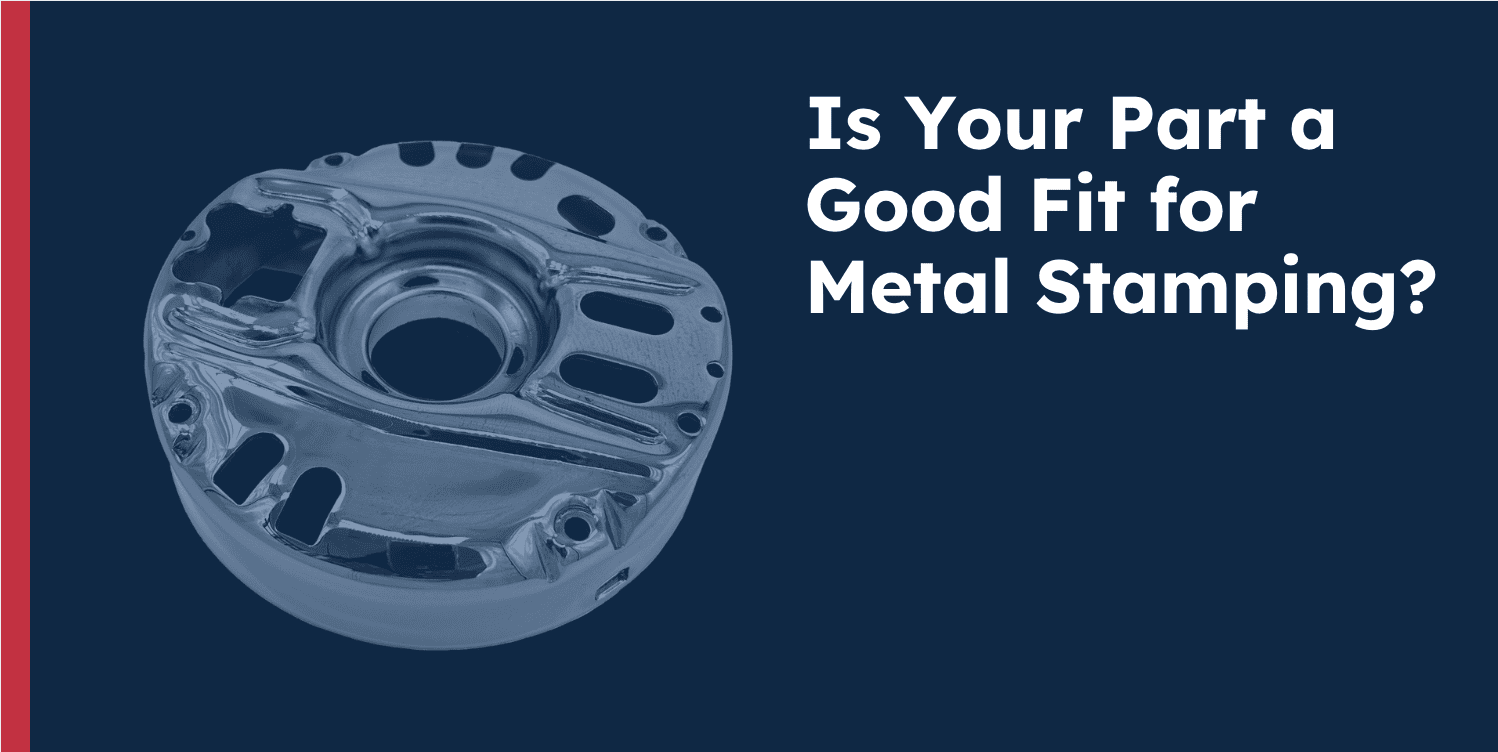
Is Your Part a Good Fit for Metal Stamping?
6 Questions to Ask Before You Send an RFQ
Most stamping projects that go sideways don’t fail on the press. They fail months earlier, when a part that was never a good fit for stamping gets sent out for quotes anyway.
The result is familiar to any buyer or engineer who has been through it. Tooling quotes come back far higher than expected. Piece prices don’t hold once secondary operations are added. Or the program stalls because nobody can agree on annual volume.
At Boehm Pressed Steel, we’d rather have the fit conversation up front. Below are the six questions our engineering team asks before a quote ever gets built. Run your part through them and you’ll know whether stamping is the right path, and what to bring to the table when you reach out.
1. What’s your realistic annual volume?
Volume is the single biggest factor in whether stamping makes sense. A progressive die is an investment, and that investment pays back through piece-price savings across every part it produces.
Our sweet spot is roughly 100,000 to 2 million+ parts per year. Lower volumes can still work, but only when the part itself carries real value. A large, $10 component at 15,000 pieces a year can justify tooling. A 10-cent bracket at 500 pieces a year almost never will.
If you’re not sure of your estimated annual usage (EAU), that’s worth pinning down first. We can’t build an honest tooling amortization plan without it.
2. Is the part a good size and shape for the press?
Stamping shines on parts that can be formed progressively, station by station, in a single die. Brackets, plates, mounts, guards, panels, and small enclosure components are classic fits.
Three things push a part outside that sweet spot:
- Very large parts. Bigger parts need more stations to fully develop, and a press bed only has so much room.
- Deep draws. Basins, deep cups, and tanks often call for specialized deep-draw equipment.
- Micro parts. Extremely small components are better suited to dedicated micro-stamping shops.
If your assembly includes one oversized part, don’t write off the whole program. Smaller subcomponents in the same assembly are often a great fit.
3. How many secondary operations does it need?
The beauty of a progressive die is that the part comes off the press finished, or close to it. Every secondary operation after the press adds handling, labor, and cost.
One or two downstream steps like welding or hardware insertion are common and manageable. But a part that needs multiple hands on it after stamping can lose the cost advantage that made stamping attractive in the first place.
Often the fix is in the design. Moving a tab, opening up a hole, or loosening a non-critical tolerance can bring an operation back into the die.
4. Is it currently a casting, forging, or machined part?
Some of the best stamping opportunities don’t start as stampings at all. Many cast and machined components were designed that way years ago and never revisited.
Converting a casting to a stamping can cut weight, reduce cost, shorten lead times, and lower the carbon footprint of the part. It takes engineering work up front, which is exactly where our in-house design team earns its keep.
If you have a cast or machined part that’s expensive, slow, or sourced overseas, it’s worth a second look.
5. Is the design still flexible?
The earlier we get involved, the more value we can add. Parts that are still in development, or due for a redesign, give us room to engineer manufacturability in rather than work around it.
That doesn’t mean the part needs to be brand new. Established products going through a refresh, cost-down, or supply-chain change are ideal candidates. What matters is that someone on your team can approve small design changes that make a big difference on the press.
6. Are you looking for a supplier or a partner?
If the only goal is the lowest bid on a finished print, stamping suppliers become interchangeable. That’s rarely where the real savings are.
The programs that deliver the most value are long-term relationships. Your supplier understands your product, flags design improvements, manages tooling, and scales with your volume. Many of our customer relationships have run 10 years or more.
If you’re consolidating suppliers, reshoring from overseas, or tired of chasing quality issues, that’s the conversation we want to have.
What to bring to the first conversation
If your part checked most of these boxes, you’re in a strong position to get an accurate quote quickly. To speed things up, have these ready:
- Prints and solid models (CAD), if available
- Estimated annual usage (EAU) and any growth forecast
- Material and thickness
- Where the part is in its lifecycle: design, production, or redesign
- What’s driving the change: cost, quality, capacity, or a second source
- Target timing for quotes and first delivery
Don’t have everything? That’s fine. Our engineers can work from prints, samples, or even an existing part.
Let’s talk about your part
Boehm Pressed Steel has been designing tooling and producing precision metal stampings in Valley City, Ohio for decades. Our in-house tooling and engineering team helps manufacturers in ag equipment, industrial products and HVAC, mining, and recreational and marine markets get better parts at a better total cost.
Not sure if your part is a fit? Send us a drawing and we’ll tell you honestly. Contact Boehm today to start the conversation.